
Commercial cabling should leave behind a dependable physical layer and a clear record of every path, endpoint, and handoff.
UaPtoTech installs copper and fiber infrastructure from pathway planning through termination, fusion splicing, enclosure work, testing, rack organization, labeling, and turnover. Materials and verification are matched to distance, bandwidth, environment, equipment, and project specifications.
Plan the pathway before the pull.
Outlet locations, device power, ceiling access, support methods, rack capacity, backbone routes, and future service all affect the final system.
Routes and supports
Ceiling conditions, sleeves, supports, transitions, fire-rated boundaries, and rack or demarc locations are reviewed before installation begins.
Copper and fiber
Cat6 drops, single-mode or multimode backbone, enclosures, distribution, fusion splicing, connectorization, and service loops are coordinated by scope.
Rack-side handoff
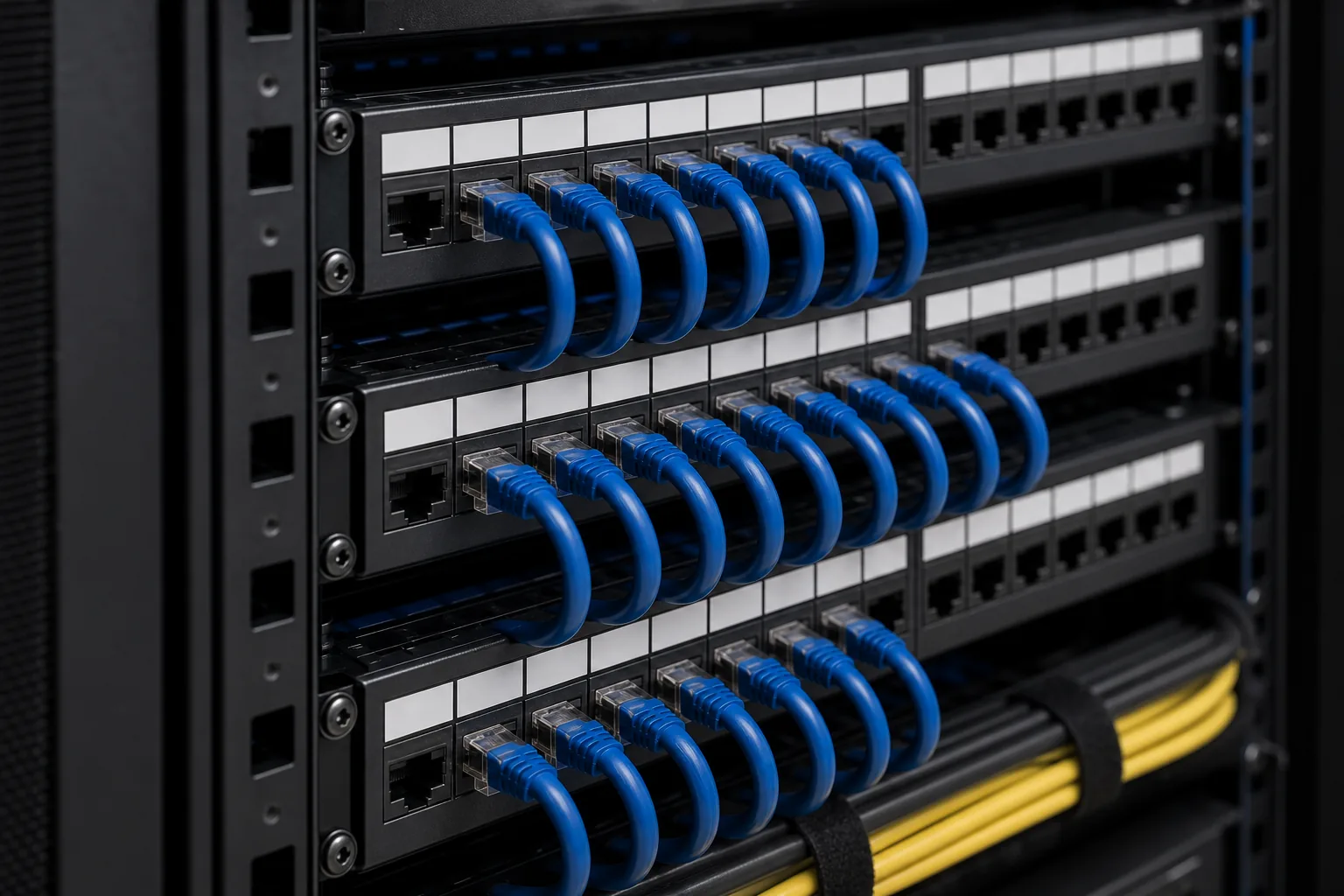
Patch panels, cable management, labels, port schedules, test results, and switch-side access remain readable after turnover.
Typical cabling and fiber scope
- Plan and specification review, site survey, and route planning
- Commercial Cat6 cabling for data, voice, and PoE devices
- Single-mode and multimode fiber backbone installation
- Fusion splicing, connectorization, enclosures, and distribution
- Patch panels, faceplates, racks, cable management, and labeling
- Qualification, certification, OTDR, optical-power, or continuity testing as specified
A handoff the next technician can follow.
UaPtoTech can provide matching endpoint labels, port and drop schedules, rack and pathway photos, test results, device locations, and agreed as-built updates. Fluke certification and per-link reports are available when the project specification requires them.
Before the site walk
Do you install and terminate fiber?
Yes. UaPtoTech works with single-mode and multimode fiber, including pathway installation, fusion splicing, connectorization, enclosures, distribution, OTDR or power-meter testing, troubleshooting, and repair.
Can you add drops to an existing rack?
Yes. Existing pathways, panel capacity, switch location, labeling, and cable management are reviewed first so the new work fits the current environment instead of creating a second disconnected system.
What testing is included?
The proposal identifies the required verification level. That may range from qualification and continuity checks to Fluke per-link certification, OTDR traces, or optical-power measurements with project-specific reports.